

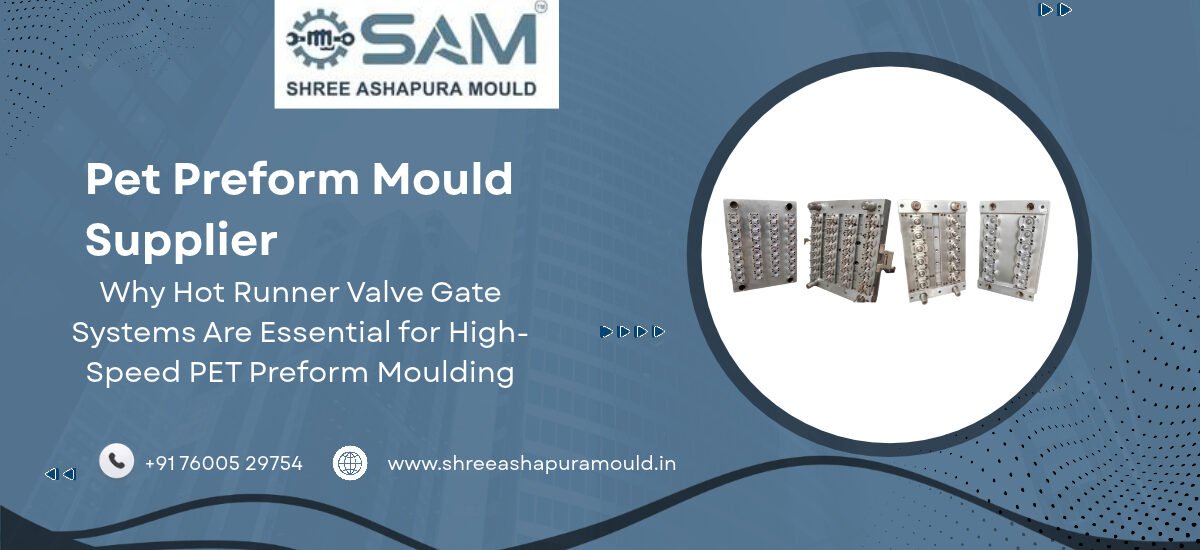
Why Hot Runner Valve Gate Systems Are Essential for High-Speed PET Preform Moulding
In high-volume PET bottle preform manufacturing, achieving a clean gate vestige, consistent preform weight, and minimal cycle time depends heavily on the design of the melt delivery system. While cold runner or open thermal gate systems may work for general plastic parts, PET preform moulding relies on hot runner valve gate systems to maintain high productivity and strict quality standards.
Because PET (Polyethylene Terephthalate) is highly sensitive to melt temperature, shear stress, and thermal degradation, a valve-gated hot runner manifold provides precise control over resin flow directly into each cavity gate.
Here is a technical analysis of why valve gate technology is the industry standard for high-speed PET preform injection moulding.
1. Clean Gate Vestige & Smooth Preform Base
In stretch blow moulding, any excess plastic or sharp protrusion (gate nub) at the bottom center of the preform causes major problems:
Puncturing During Blowing: A sharp or long gate stub can puncture the stretch rod during the high-pressure inflation phase.
Base Stress & Crystallization: Excess plastic at the gate cools slowly, causing localized crystallization (white haze). Un-oriented crystalline PET is brittle and prone to cracking under carbonation or vertical pressure.
How Valve Pins Solve This
A pneumatically or hydraulically actuated valve pin moves forward inside the hot runner nozzle at the end of the injection phase. The pin mechanically seals the gate orifice flush with the cavity surface. This results in a smooth, flat gate vestige with zero gate stringing or long nubs.
2. Elimination of Runner Scrap & Recycled Regrind
Cold runner systems create heavy sprue and runner networks that must be re-ground and blended back into raw material. However, regrinding PET introduces significant production challenges:
Acetaldehyde (AA) Generation: Regrinding subjects PET to repeated heat histories, raising AA levels and causing off-flavors in packaged drinking water.
Dust & Fines: PET regrind creates fine dust that causes uneven melting in the barrel, leading to black specs and melt instability.
A direct-valve-gated hot runner keeps the resin in a molten state within the manifold throughout the entire production run, completely eliminating runner waste.
3. Faster Cycle Times & Uniform Multi-Cavity Filling
In high-cavity preform moulds (such as 16, 24, 32, or 48 cavities), all cavities must fill at the exact same rate to prevent preform-to-preform weight variation.
Sequential Shut-off Control: Valve gate systems allow precise timing control for each pin shut-off, ensuring that every cavity receives identical packing pressure.
Instant Mechanical Closure: Unlike thermal gates (which rely on cooling the gate area to freeze resin flow before mould opening), valve pins physically block the gate immediately after packing. This allows the mould to open much earlier, cutting seconds off every injection cycle.
4. Temperature Precision & Reduced Shear Stress
PET has a narrow processing temperature window (typically $270^\circ\text{C}$ to $290^\circ\text{C}$). Overheating degrades the polymer chain length (lowering Intrinsic Viscosity or IV), while under-heating leads to un-melted granules and high injection pressure.
Modern hot runner valve gate manifolds feature:
Balanced Flow Channels: Natural-balanced manifold layouts ensure equal flow distance and shear rate from the main machine nozzle to every cavity.
Independent Zone Heating: PID-controlled heating elements around each nozzle tip prevent cold slugs and thermal degradation across the entire tool face.
Related Precision Tooling Solutions
Upgrade your preform production line with our engineered PET Preform Mould configurations featuring integrated valve gate hot runner technology.
Manufacturing wide-mouth food containers? Read about our high-efficiency PET Jar Mould designs.
Complete your packaging ecosystem with high-speed PP Cap Mould systems.




 Users Today : 1
 Users This Month : 3
 Total Users : 4