

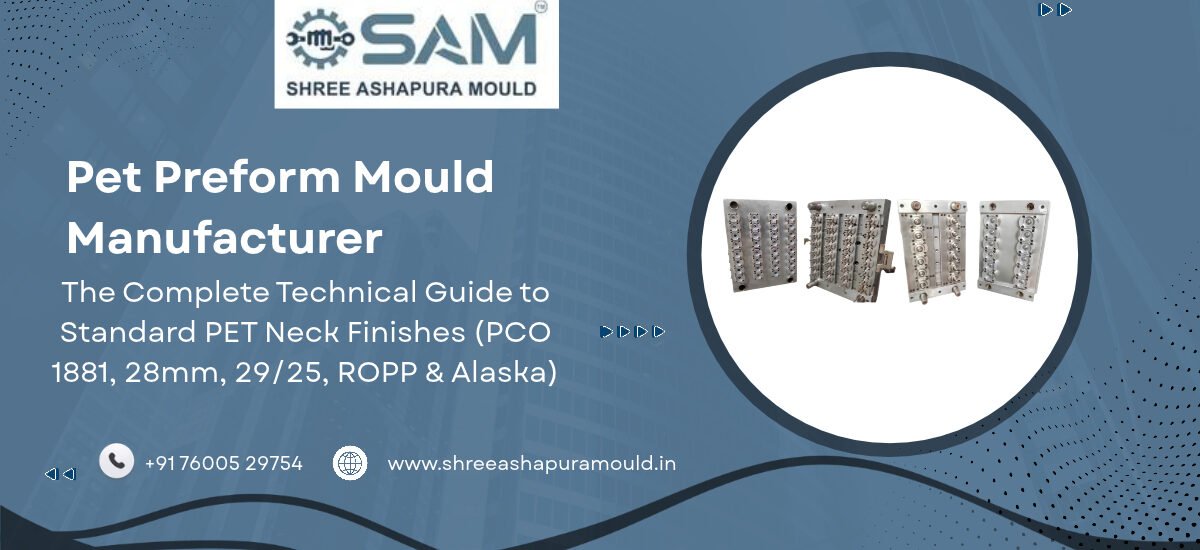
The Complete Technical Guide to Standard PET Neck Finishes (PCO 1881, 28mm, 29/25, ROPP & Alaska)
In the PET container and bottling industry, selecting the right neck finish is a crucial design decision that impacts resin weight, closure performance, cycle speed, and line compatibility. The neck finish refers to the precise thread profile, sealing lip, tamper-evident band ring, and support ledge dimensions at the top of a PET preform.
Because the neck area is injection-moulded to its final dimensions during the preform stage and is not altered during stretch blow moulding, the accuracy of your PET preform mould neck rings dictates the leak-proof performance of the final bottle.
Here is a technical guide to the most widely used PET neck finishes across carbonated drinks, packaged water, edible oil, and pharmaceutical packaging.
Technical Breakdown of Core Neck Types
1. PCO 1881 (Plastic Closure Only – 28mm Short Neck)
Developed to reduce resin consumption in global carbonated soft drink lines, PCO 1881 replaced the older, heavier PCO 1810 standard.
Weight Reduction: Reduces neck weight by over 1.3 grams per preform compared to PCO 1810.
Pressure Resistance: Engineered with precise continuous threads to withstand high internal gas pressures ($4.0\text{ to }4.5\text{ bar}$) without thread stripping or leakage.
Mould Design Note: Requires precise neck ring cooling to prevent thread ovality or pitch distortion during fast ejection cycles.
2. 29/25 Neck Finish (Lightweight Still Water)
The 29/25 standard is widely adopted in high-speed bottled water plants prioritizing sustainability and material cost reduction.
Streamlined Height: Features a total neck height of approximately $14.2\text{ mm}$, significantly reducing PET material usage in the preform neck area.
Sealing Interface: Utilizes a bore-seal or plug-seal mechanism inside the closure rather than top-edge compression seals.
3. Alaska Neck Finish (3-Thread Quick-Lock)
Designed specifically for non-carbonated applications, the Alaska neck uses a 3-start thread execution.
Fast Application: Allows closures to seal completely with less than a full turn, increasing capping efficiency on high-speed bottling lines.
Tamper Evidence: Incorporates a sharp retaining bead that snaps into the cap’s safety ring during first-time application.
4. ROPP & Threaded Pharmaceutical Finishes
For pharmaceutical bottles, liquid oral syrups, and agrochemicals, neck finishes must accommodate metal aluminum roll-on pilfer-proof caps or child-resistant closures (CRC).
Stepped Retention Ring: Designed to support aluminum crimping rollers that form threads over the plastic neck without cracking the PET wall.
Zero Leakage Tolerances: Requires tight dimensional control on the top sealing surface to prevent liquid seepage.
Key Considerations for Mould Design & Neck Ring Tooling
To ensure seamless production when running different neck finishes in your factory:
Interchangeable Neck Rings: High-quality preform moulds feature modular split neck ring inserts. This allows manufacturers to switch between neck designs (e.g., from 28mm PCO to 29/25) on the same mould base with minimal downtime.
Hardened Tool Steel: Neck rings experience constant sliding friction against locking tapered blocks. Utilizing hardened steel (HRC 52–56) with anti-corrosion coatings prevents thread rounding and flash formation.
Draft Angle Accuracy: Proper draft angles on thread flanks ensure clean ejection without dragging or distortion on cap sealing lips.
Related Tooling & Closure Solutions
Looking for preform tooling built with precision neck rings? Explore our custom PET Preform Mould configurations.
Producing wide-mouth containers for foods or powders? Read our technical guide on PET Jar Mould neck design.
Seeking matching closures for your neck finishes? Discover our high-speed PP Cap Mould solutions.



 Users Today : 1
 Users This Month : 3
 Total Users : 4