

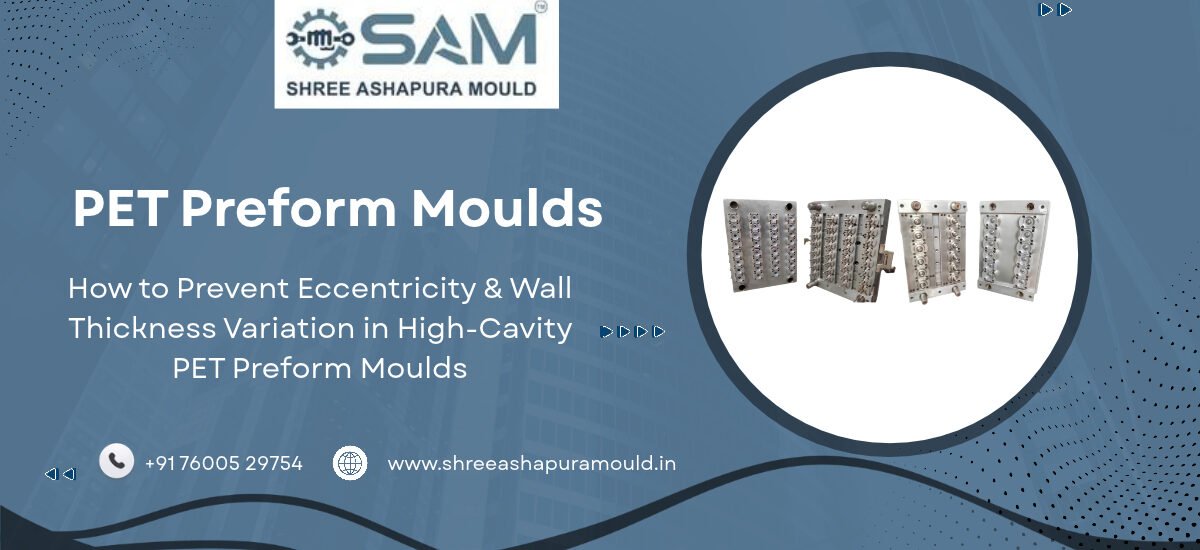
How to Prevent Eccentricity & Wall Thickness Variation in High-Cavity PET Preform Moulds
In high-volume PET injection moulding, maintaining uniform wall thickness across every preform is critical to producing strong, clear, and defect-free bottles. Eccentricity—a condition where the cross-sectional wall thickness of a preform is non-uniform or off-center—is one of the most common causes of bottle bursting, localized structural weakness, and high scrap rates during stretch blow moulding.
When an eccentric preform is heated in a stretch blow moulding oven, the thinner side heats faster and stretches more than the thicker side. This leads to unbalanced plastic distribution in the final bottle, causing thin body panels, weak bases, and failed top-load pressure tests.
Understanding the mechanical causes of core-cavity misalignment helps plant managers and engineers eliminate eccentricity at the source.
Technical Causes of Preform Eccentricity
Preform wall thickness variation is primarily caused by physical shifts between the core pin, cavity sleeve, and neck ring assembly during the injection cycle.
       [ Core Pin ]
          |   |  <-- Uneven Resin Flow / Thermal Shift
   ( Thin |   | Thick Wall )
          |   |
      [ Cavity Sleeve ]
1. Inadequate Taper Locking on Core & Cavity Assemblies
The core pin and cavity sleeve must maintain concentric alignment down to sub-micron tolerances. If a mould lacks robust self-centering taper locks, the clamping pressure or high injection force can cause the core pin to sit slightly off-center inside the cavity.
2. High Injection Pressure & Core Deflection
During the initial filling phase, PET resin enters the bottom gate at extreme pressures. If the resin flow from the hot runner nozzle is asymmetrical, it creates unequal lateral forces on the tip of the core rod. This uneven pressure front pushes the cantilevered core to one side, resulting in a thin wall on the side facing the pressure and a thick wall on the opposite side.
3. Uneven Wear on Neck Ring Components
The neck ring assembly acts as the locating bridge between the top of the core pin and the upper cavity block. Continuous high-speed opening and closing, combined with thermal cycling, causes mechanical wear on the neck ring taper guides. Even minor clearance play allows the core pin to tilt during injection.
4. Non-Uniform Cooling Circuit Efficiency
When core cooling channels suffer from scale buildup or restricted water flow, heat accumulates on one side of the tool steel. Thermal expansion causes the cavity block and core pin to expand unequally, shifting the geometric center of the cavity relative to the core base.
Engineering Solutions to Eliminate Wall Thickness Variation
To prevent eccentricity and ensure consistent preform weight across all cavities, mould manufacturers and process technicians implement specific design standards:
1. Integrate Dual Taper Self-Centering Locks
High-precision multi-cavity moulds utilize dual taper locking systems. These taper locks are ground into both the core plate and cavity block. As the clamping unit closes, the tapers engage firmly to force the core pin into dead-center alignment before the melt front reaches the gate.
2. Balance Hot Runner Valve Gate Flow
Balanced flow channels within the hot runner manifold are essential to prevent core push. Equalizing manifold runner lengths, nozzle orifice diameters, and valve pin timing ensures that molten PET enters the cavity evenly from all directions, neutralizing lateral forces on the core rod.
3. Implement Robust Core Bubbler Cooling Systems
Core rods must feature dedicated inner cooling tubes (bubblers or baffles) that deliver cold water directly to the tip of the core rod. Maintaining consistent core temperature prevents uneven metal expansion and ensures fast, balanced solidification of the resin wall.
Plant Operations Checklist:
Periodically measure core alignment using dial indicators during tool maintenance.
Use descaling flushes on cooling channels to remove rust and mineral deposits.
Inspect neck ring split lines for burrs, wear, or trapped resin debris that prevents flush closing.
Benefits of Concentric Preforms in Downstream Production
Eliminating wall thickness variations provides immediate operational benefits:
Consistent Stretch Blow Moulding: Even material distribution during inflation results in uniform bottle wall strength.
Higher Drop Test & Top-Load Ratings: Prevents thin spots that crumble under vertical stacking loads in packaging warehouses.
Lower Scrap & Energy Costs: Uniform preforms absorb infrared oven heat evenly, eliminating the need to over-heat preforms to compensate for thick walls.
Related Precision Tooling Solutions
Looking to upgrade your preform tooling setup? Explore our engineered PET Preform Mould solutions featuring precision self-centering alignment systems.
Manufacturing wide-mouth food containers? Read about our custom designs for PET Jar Mould production.
Need high-precision closures for your preform bottle line? Discover our multi-cavity PP Cap Mould solutions.


 Users Today : 1
 Users This Month : 3
 Total Users : 4