

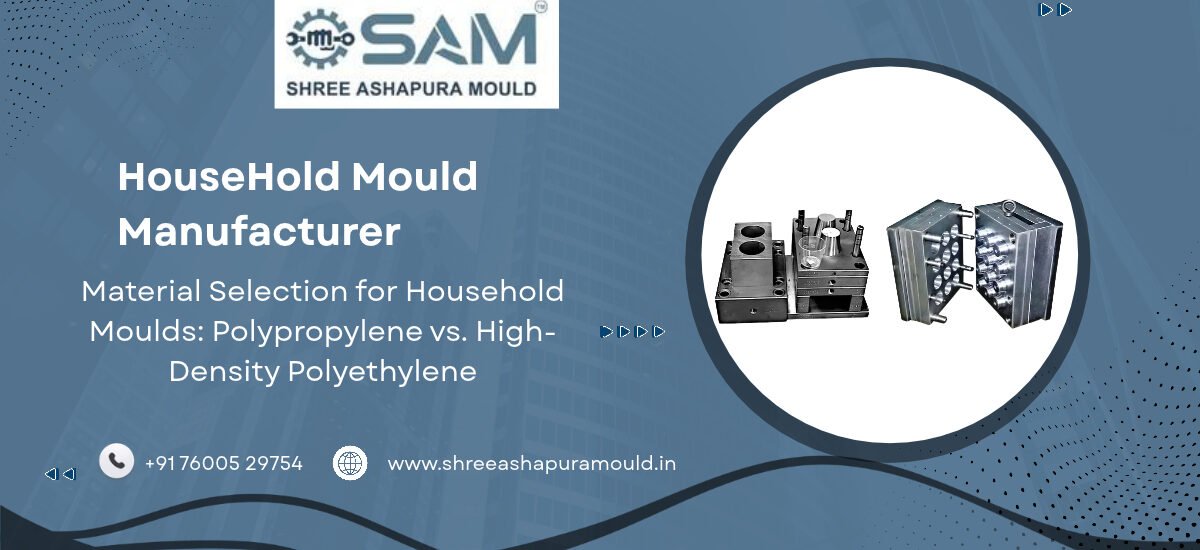
Material Selection for Household Moulds: Polypropylene vs. High-Density Polyethylene
In consumer houseware product manufacturing, selecting the optimal thermoplastic resin dictates mould design parameters, core cavity cooling layouts, ejection mechanisms, and part structural performance. The two most widely used semi-crystalline commodity polymers in household plastic moulding are Polypropylene (PP) and High-Density Polyethylene (HDPE).
While both polyolefins offer chemical resistance, moisture barrier properties, and economical processing, their distinct molecular chain structures create different melt flow indices, volumetric shrinkage rates, flexural moduli, and low-temperature impact behaviors.
Designing an efficient house hold mould requires a thorough mechanical evaluation of Polypropylene versus High-Density Polyethylene to optimize cavity steel dimensions and cooling efficiency.
Material Property and Engineering Comparison
Flexural Modulus and Stiffness: Polypropylene exhibits higher flexural modulus and tensile strength, making it ideal for rigid containers, snap-fit lids, and structural stacking bins. High-Density Polyethylene offers greater flexibility and impact toughness.
Low-Temperature Impact Resistance: High-Density Polyethylene maintains high impact strength and crack resistance below freezing temperatures, whereas standard Polypropylene homopolymers become brittle in cold environments.
Volumetric Mould Shrinkage: High-Density Polyethylene exhibits higher differential volumetric shrinkage compared to Polypropylene, requiring larger shrinkage scaling factors during core-cavity CNC steel machining.
Melt Flow Fluidity: Polypropylene grades offer higher melt flow rates for thin-wall multi-cavity injection, whereas High-Density Polyethylene exhibits higher melt viscosity and shear resistance.
Stress Whitening and Hinge Property: Polypropylene possesses unique molecular fatigue resistance allowing the moulding of functional living hinges, whereas High-Density Polyethylene stress-whitens and fails under repetitive bending.
Tooling Design Adjustments for Polyolefin Processing
1. Shrinkage Compensation in Core-Cavity Tooling
Both PP and HDPE are semi-crystalline polymers that crystallize as they cool from a molten state, causing dimensional contraction inside the cavity.
HDPE Tooling Scaling: Because HDPE exhibits high volumetric shrinkage, core pin diameters and cavity dimensions must be oversized in CAD models using precise shrinkage coefficients to achieve final part dimensional tolerances.
PP Tooling Scaling: Polypropylene exhibits slightly lower and more predictable isotropic shrinkage, allowing tighter dimensional control on living hinges, snap-lock rims, and internal thread profiles.
2. Cooling Circuit Design and Warpage Control
Differential cooling rates across plastic part walls lead to asymmetrical crystallization, causing differential thermal stress and part warpage.
High-Conductivity Tool Steel Inserts: Toolmakers utilize copper alloy inserts or high-conductivity hardened stainless steels around deep core corners to accelerate thermal energy extraction when moulding thick HDPE base sections.
Balanced Core Cooling Passages: High-density cooling water circuits are engineered closer to the cavity surface to ensure uniform temperature distribution across large-area household lids, storage trays, and flat basin walls.
3. Ejection System Mechanics
Because HDPE is softer and more flexible than PP at elevated ejection temperatures, ejection mechanisms must be engineered to prevent part distortion or pin push-through:
Stripper Plate Ejection: For deep-draw round containers like buckets and tubs, a continuous 360-degree stripper plate applies uniform forward force along the entire rim shoulder, preventing edge buckling.
Air Assist Ejection Valves: Integrated pneumatic air poppet valves inside the core tip break the internal vacuum before mechanical ejection, allowing smooth part release without wall stretching.
Engineering Selection Standard for Household Products
Specify Polypropylene (PP) For: Structural food storage containers, living-hinge boxes, microwave-safe kitchenware, rigid organizer drawers, and snap-tight sealing lids requiring high stiffness and hinge durability.
Specify High-Density Polyethylene (HDPE) For: Heavy-duty laundry baskets, outdoor buckets, flexible basin tubs, deep-freeze storage containers, and impact-resistant household crates requiring crack resistance at low temperatures.
Related Precision Tooling Solutions
Looking for high-performance consumer product tooling? Explore our dedicated House Hold Mould manufacturing range engineered for polyolefin resin processing.
Require high-cavity packaging tooling? Learn about our advanced PET Preform Mould product range.
Complete your container line setup with custom-engineered PP Cap Mould solutions.



 Users Today : 8
 Users This Month : 182
 Total Users : 244