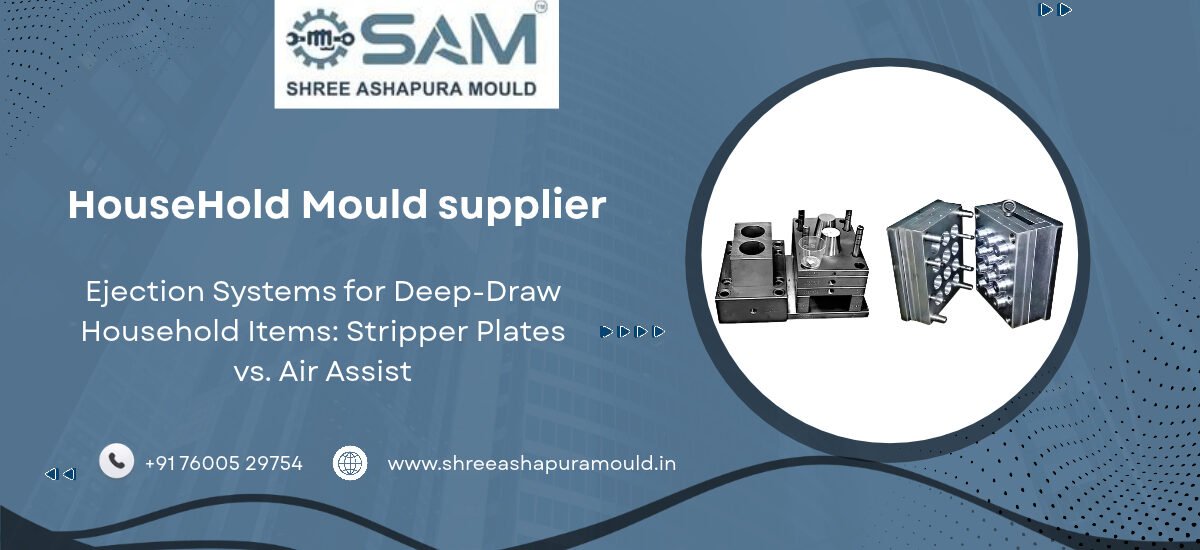
Ejection Systems for Deep-Draw Household Items: Stripper Plates vs. Air Assist
In houseware plastic injection moulding, deep-draw items—such as waste bins, storage tubs, buckets, laundry baskets, and tall measuring pitchers—present unique mechanical ejection challenges. Deep-draw parts feature large core contact surface areas, long draw depths, and thin sidewalls.
As a molded thermoplastic part cools over a deep core pin, volumetric thermal shrinkage causes the plastic material to grip the core tightly. Simultaneously, as the part begins to slide off the closed core end, a strong internal vacuum forms between the steel core face and the plastic part base.
Attempting to eject deep-draw items using standard small ejector pins results in pin push-through, wall whitening, cosmetic mark defects, or permanent part deformation. Designing an efficient house hold mould for deep containers requires integrating mechanical stripper plates and pneumatic air assist poppet valves.
Here is an engineering overview of mechanical stripper plate actuation, vacuum-breaking air valves, and combined ejection mechanics for deep-draw household tooling.
Technical Mechanics of Deep-Draw Part Ejection
   [ Mold Opening Phase ]
             |
   [ Air Valve Actuation ] --------> Breaks Internal Core Vacuum
             |
   [ Stripper Plate Forward Stroke ] -> Applies 360-Degree Continuous Rim Force
             |
   [ Clean Part Release ]
Core Surface Friction Resistance: As semi-crystalline polymers like polypropylene cool, radial contraction generates high frictional force along the entire vertical core surface.
Vacuum Pressure Locking: The sealed top face of a deep container creates an airtight seal against the core tip. Attempting forward motion without venting creates a negative pressure vacuum that pulls the plastic inward.
Ejection Force Concentration: Small-diameter ejector pins concentrate forward mechanical force over localized tiny surface areas, exceeding the yield strength of warm plastic walls.
Ejection System Engineering Comparison
1. Mechanical Stripper Plate Mechanisms
A stripper plate is a floating steel plate precision-machined to match the exact perimeter contour of the core pin shoulder.
360-Degree Continuous Force Distribution: Unlike localized ejector pins, a stripper plate contacts the entire bottom rim shoulder of the plastic part simultaneously. Forward mechanical movement pushes the part off the core evenly, preventing wall bending or buckling.
Guided Alignment Motion: Stripper plates are mounted on precision guide pillars with self-lubricating bronze bushings, ensuring perfectly parallel forward motion during the ejector hydraulic stroke.
Zero Ejector Pin Mark Aesthetics: Because no ejector pins touch the internal or external container surfaces, the finished product exhibits smooth cosmetic surfaces completely free of pin line marks.
2. Pneumatic Air Assist Poppet Valves
To eliminate vacuum locking at the closed end of deep core pins, toolmakers integrate spring-loaded air poppet valves directly into the core tip face.
Internal Vacuum Destruction: Prior to or during mechanical stripper movement, compressed air is routed through internal core channels, forcing the air poppet valve pin outward against a light spring.
Air Cushion Formation: High-pressure compressed air enters the tiny gap between the core tip and the interior base of the plastic container. This breaks the vacuum seal and forms a thin air film cushion that floats the container off the core steel.
Positive Sealing Face: Upon air pressure release, internal spring tension pulls the poppet valve pin tightly back into its tapered steel seat, maintaining a flush core surface during subsequent melt injection.
3. Combined Hybrid Ejection Architecture
For heavy-duty or long-draw household items like large laundry hampers and industrial storage bins, high-efficiency moulds combine both technologies into a synchronized multi-stage ejection sequence:
Stage One Air Release: Pneumatic air valves in the core tip actuate first, injecting a burst of compressed air to break the internal vacuum and initiate part detachment.
Stage Two Mechanical Advance: The hydraulic ejector system advances the stripper plate forward, applying continuous perimeter force to slide the pre-loosened container smoothly off the full length of the core pin.
Tooling Application Engineering Standard
Standard Ejector Pin Application: Shallow flat household items including food tray lids, organizer dividers, shallow dishes, and coasters where draw depth is minimal.
Stripper Plate and Air Assist Application: Deep-draw container tooling for buckets, storage tubs, waste bins, pitchers, and tall baskets requiring uniform rim force and vacuum-free release.
Related Precision Tooling Solutions
Looking for high-efficiency consumer product tooling? Explore our dedicated House Hold Mould manufacturing range engineered for deep-draw container ejection.
Require high-cavity packaging tooling? Learn about our advanced PET Preform Mould product line.
Complete your closure sealing line with custom-engineered PP Cap Mould solutions.



 Users Today : 6
 Users This Month : 180
 Total Users : 242