

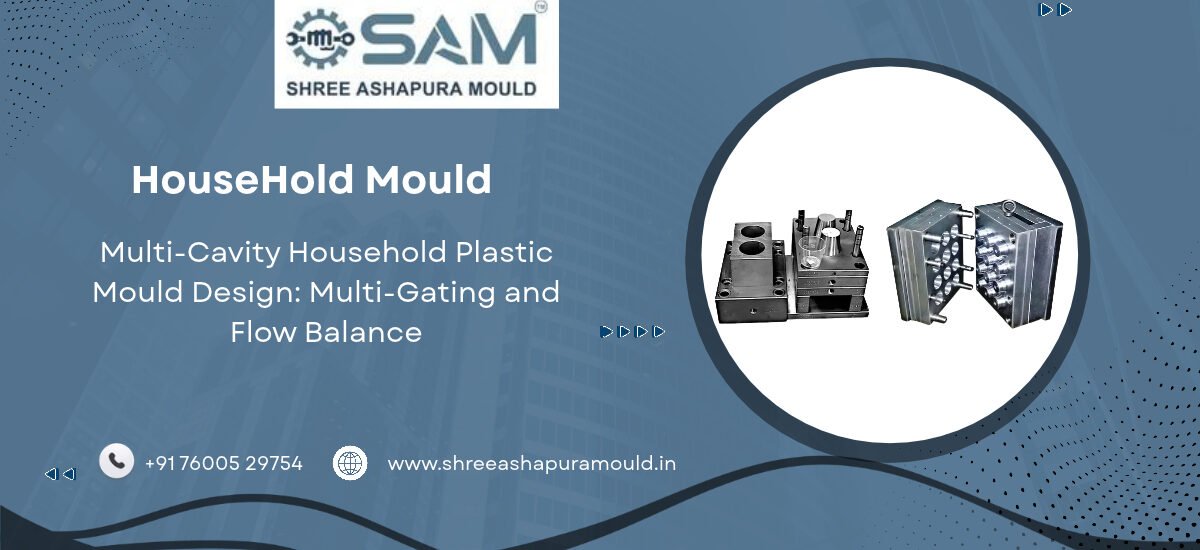
Multi-Cavity Household Plastic Mould Design: Multi-Gating and Flow Balance
Household plastic products—such as storage containers, kitchenware, buckets, thin-wall crates, and organizer trays—are produced in high-volume multi-cavity injection moulds to meet consumer demand and optimize unit production costs. However, household parts often feature large projected surface areas, complex ribs, deep draw depths, and non-uniform wall sections.
Designing a high-cavity house hold mould requires balancing the plastic melt flow across every individual cavity to prevent differential shrinkage, warpage, sink marks, and flash. If resin fills one cavity faster than another, pressure imbalances generate internal stresses that compromise part dimensions and structural load strength.
Here is an engineering overview of runner system balancing, multi-gate positioning, core deflection control, and clamp force distribution for multi-cavity household plastic tooling.
Technical Challenges in Multi-Cavity Household Tooling
[ Symmetric Melt Delivery ] --> [ Uniform Cavity Filling ] --> [ Balanced Packing Pressure ]
Melt Shear Differentiation: Polymer melt traveling through runner channels experiences frictional shear heat, changing viscosity between inner and outer channels if runner geometry is unbalanced.
Core Pin Deflection in Deep Draw Items: High injection pressure filling deep container cavities exerts lateral hydraulic force, causing core pins to flex and create unequal wall thicknesses.
Differential Volumetric Shrinkage: Unbalanced pressure distribution during the packing phase causes uneven part shrinkage, leading to warped container rims and poor stacking alignment.
Clamping Force Asymmetry: Non-uniform pressure distribution across the mould face causes uneven plate flexure and parting line flash on outer cavities.
Key Engineering Principles for Melt Flow Balance
1. Naturally Balanced Hot Runner Systems
To achieve identical filling time, pressure drop, and melt temperature across every cavity in a multi-cavity house hold mould, toolmakers design naturally balanced geometrically symmetric hot runner manifolds:
Equal Path Lengths: The melt distance from the main machine sprue to every individual cavity gate is identical in length, channel diameter, and turn angle.
Shear Management Channeling: Melt channel layouts incorporate melt-flipper or re-orientation geometry to re-mix shear-heated outer melt layers with cooler center core resin before entering the gate.
2. Multi-Gating Strategies for Large Surface Household Parts
For large-format household items such as laundry baskets, storage tubs, and flat trays, a single injection gate is insufficient to fill the cavity without generating excessive pressure drops.
Sequential Valve Gating: Multiple hot runner nozzles are placed across the part surface. Pneumatically or hydraulically actuated valve pins open sequentially, allowing the melt front to advance smoothly from one gate to the next without creating weak weld lines or air traps.
Symmetric Gate Placement: Gates are located near structural geometric centers to ensure equal radial flow paths toward the outer part perimeters.
3. Core Alignment and Interlocking Controls
In deep-draw household containers such as buckets and tall bins, maintaining uniform wall thickness around the entire perimeter requires rigid core support:
Four-Corner Taper Interlocks: Precision ground taper locks positioned around individual cavity inserts mechanically lock the core pin to the cavity sleeve prior to resin injection, preventing core deflection under high melt velocity.
Core Base Support Sleeves: Heavy-duty support pillars back up the core clamping plate, absorbing high hydraulic cavity pressures without plate deflection.
Tooling Application Engineering Standard
Naturally Balanced Cold/Hot Runners: Essential for standard medium-sized multi-cavity household goods to guarantee identical cavity filling and uniform part weight.
Sequential Multi-Gate Hot Runner Systems: Required for large-area, thin-wall, or long-flow-length household products to minimize required injection pressure and eliminate visible weld lines.
Related Precision Tooling Solutions
Looking for high-volume consumer product tooling? Explore our complete House Hold Mould manufacturing range engineered for multi-cavity precision.
Require industrial container tooling? Learn about our advanced PET Preform Mould configurations.
Complete your packaging lineup with custom-engineered PP Cap Mould solutions.



 Users Today : 6
 Users This Month : 180
 Total Users : 242