

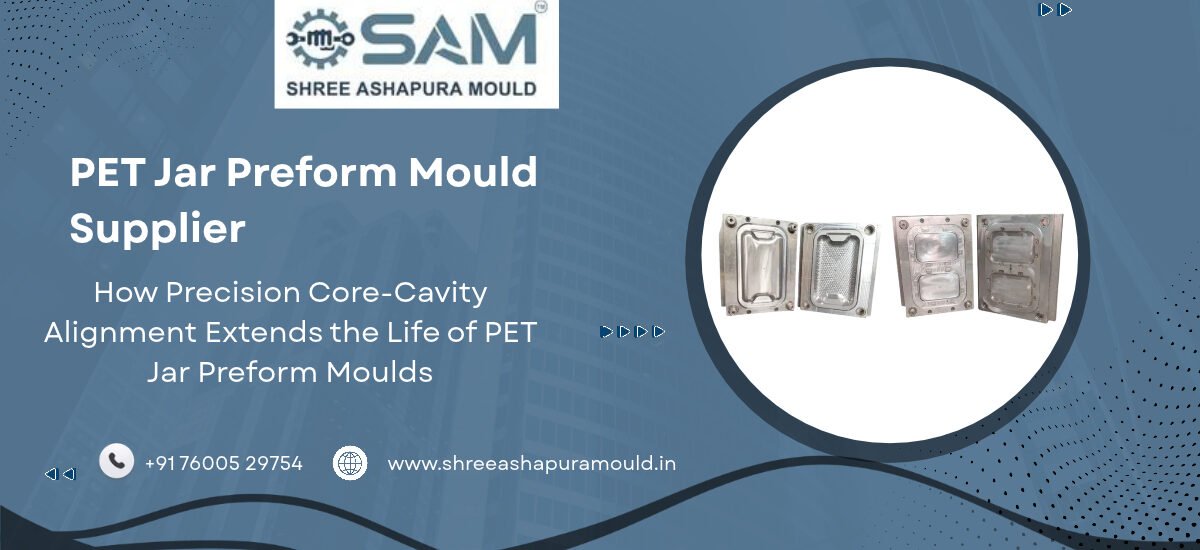
How Precision Core-Cavity Alignment Extends the Life of PET Jar Preform Moulds
A high-cavity PET jar preform mould is a major capital investment designed to operate continuously across millions of injection cycles. However, because wide-mouth jar preforms feature large neck diameters, heavy shot weights, and high clamping requirements, the internal components of the mould experience extreme mechanical stress, thermal cycling, and high dynamic injection forces.
The primary mechanical factor determining whether a mould lasts for 3 million cycles or over 10 million cycles is precision core-cavity alignment.
When core pins, neck rings, and cavity sleeves shift even fractions of a millimeter out of concentricity, steel-to-steel friction, uneven wear, flash formation, and core pin fatigue accelerate rapidly. Maintaining sub-micron alignment tolerances preserves tool steel integrity and significantly extends overall mould lifespan.
Mechanical Impacts of Core-Cavity Misalignment
During every injection stroke, molten PET enters the cavity at extreme hydraulic pressures ($800\text{ to }1400\text{ bar}$). If the core pin is not firmly centered within the cavity sleeve, these massive hydraulic forces trigger severe mechanical degradation:
   [ Centered Core Pin ]              [ Misaligned Core Pin ]
      Equal Clearance                    Uneven Clearance
    +-----------------+                +-----------------+
    |  |   Core   |   |                | |   Core     |  |
    |  |   Pin    |   |                | |   Pin      |  |
    +-----------------+                +-----------------+
    Equal Resin Flow                   Uneven Flow & Core Bending
1. Excessive Steel-to-Steel Wear on Neck Rings & Taper Locks
When a core pin enters a cavity slightly off-center, the alignment tapers scrape against each other during mould closure. Over time, this repetitive metal friction grinds away hardened tool steel coatings, leading to galling, scoring, and permanent loss of precision location.
2. Parting Line Damage and Flash Formation
Misalignment prevents the split neck ring halves from clamping completely flush against the cavity top face. Small gaps allow high-pressure melt to seep between steel faces, creating sharp plastic flash along the preform neck thread. Once flash occurs, trapped resin particles further crush parting line edges during subsequent closing cycles, ruining the tool face.
3. Core Pin Metal Fatigue & Bending
If resin fills one side of an un-centered cavity faster than the other, the asymmetrical pressure wave applies a continuous bending force to the tip of the cantilevered core rod. Over millions of cycles, cyclic bending stress causes micro-cracks near the core root, eventually leading to permanent core bending or catastrophic pin breakage.
Advanced Tooling Technologies for Precision Alignment
To ensure long tool life and maintain zero-defect output, high-performance wide-mouth jar preform moulds utilize specific structural alignment features:
1. Dual Taper Self-Centering Interlocks
High-durability tooling avoids relying solely on outer guide pins to align individual core-cavity pairs. Instead, each individual cavity station incorporates dedicated precision tapers:
Core Base Taper: A hardened 10° to 15° ground taper on the core holder locks directly into a matching taper inside the cavity sleeve as the tool closes.
Neck Ring Centering Flange: The neck ring assembly features guided interlocking shoulders that seat into both the cavity block and the core base simultaneously, eliminating mechanical play.
2. Hardened Tool Steel & Friction-Resistant Coatings
To withstand continuous opening and closing without scoring:
Core pins, neck rings, and cavity inserts are manufactured from high-grade martensitic stainless steels (such as DIN 1.2316 or Stavax) heat-treated to HRC 52–56.
Sliding components feature advanced Diamond-Like Carbon (DLC) or Titanium Nitride (TiN) PVD coatings to reduce friction coefficients and eliminate the need for liquid lubricants near moulding cavities.
Related Precision Tooling Solutions
Looking for long-lasting jar tooling? Explore our precision-engineered PET Jar Mould manufacturing configurations equipped with dual taper locking.
Need high-speed beverage preform tooling? Learn more about our complete PET Preform Mould product line.
Complete your packaging tooling setup with multi-cavity PP Cap Mould solutions.



 Users Today : 6
 Users This Month : 180
 Total Users : 242