

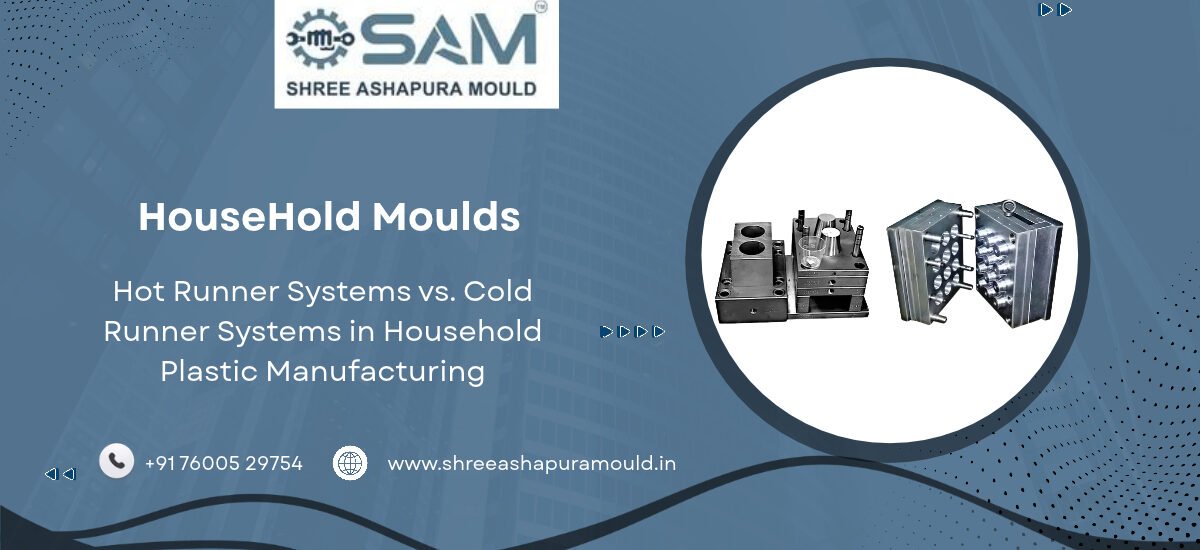
Hot Runner Systems vs. Cold Runner Systems in Household Plastic Manufacturing
In consumer houseware product manufacturing, designing the melt delivery network that transfers molten polymer from the injection moulding machine nozzle into the mould cavities is a fundamental engineering decision. Household items—such as large storage bins, multi-cavity food containers, cutlery sets, and organizing trays—require consistent melt pressure, precise temperature control, and high material efficiency.
Tooling engineers choose between cold runner systems (where the runner channel solidifies with every shot and is ejected alongside the part) and hot runner systems (where internal electrical heating elements keep the polymer molten inside sealed manifold channels).
Evaluating hot runner versus cold runner technology for a house hold mould involves analyzing material scrap savings, injection pressure drops, gate vestige cosmetics, and total production volume targets.
Structural Comparison of Melt Delivery Technologies
Material Scrap Generation: Cold runner systems generate solid runner plastic scrap with every shot that must be reground or recycled, whereas hot runner systems deliver zero sprue scrap directly into the cavity gate.
Injection Pressure Drop: Hot runner manifolds maintain constant melt temperatures along optimized circular channels, reducing pressure losses compared to long, unheated cold runner channels.
Cycle Time Efficiency: Hot runner moulds eliminate the time required to cool thick solid sprue and runner sections, directly reducing total moulding cycle times.
Tooling Mechanical Complexity: Hot runner systems incorporate internal heater cartridges, thermocouple sensors, and precision manifold blocks, requiring advanced thermal expansion clearances inside the mould base.
Gate Vestige Aesthetics: Valve-gated hot runner systems provide clean, flush gate vestiges on visible household product faces, whereas cold runner gates leave raised vestige stubs requiring manual or mechanical trimming.
Technical Mechanics of Melt Delivery Systems
1. Cold Runner System Engineering
Cold runner systems utilize machined channels along the parting line of the mould plates. As molten resin fills the channels and cavities, cold tool steel solidifies both the part and the runner framework simultaneously.
Two-Plate Cold Runner: Features a straight runner cut along the main parting line, ejecting the runner attached to the molded household part.
Three-Plate Cold Runner: Utilizes a floating runner plate that separates the runner network from the parts during mould opening, allowing automatic pinpoint gating on multi-cavity household trays and lids.
Thermal Mass Constraint: The thickest section of a cold runner determines the minimum cooling time required before mould opening, often slowing down production cycles even when the main plastic part has thin walls.
2. Hot Runner System Engineering
Hot runner systems integrate an internally heated manifold block housed within an insulated cavity plate assembly inside the mould base.
Internally vs. Externally Heated Channels: Externally heated manifolds feature smooth-bore melt channels surrounded by tubular heating elements, providing smooth polymer flow with minimal stagnation zones.
Valve Gate Technology: Mechanically driven valve pins slide forward inside nozzle tips to physically seal the gate orifice at the end of the packing phase. This eliminates gate drool, prevents stringing, and creates a perfectly flat cosmetic surface on container bases.
Thermal Expansion Clearance Controls: Because hot runner manifolds expand when heated to processing temperatures, precision expansion gaps are engineered into support pads and dowel locations to maintain alignment with cold cavity nozzles.
Tooling Application Engineering Standard
Cold Runner System Application: Short-run custom household products, single-cavity prototype tools, frequent color change applications, and low-cost commodity items where scrap regrind can be reprocessed without property degradation.
Hot Runner System Application: High-volume multi-cavity household goods, thin-wall food packaging, large-format storage tubs requiring multiple injection points, and premium cosmetic housewares requiring zero-defect surface finishes.
Related Precision Tooling Solutions
Looking for high-efficiency consumer product tooling? Explore our dedicated House Hold Mould manufacturing range engineered with advanced hot runner integration.
Require high-cavity packaging tooling? Learn about our advanced PET Preform Mould product line.
Complete your packaging lineup with custom-engineered PP Cap Mould solutions.



 Users Today : 6
 Users This Month : 180
 Total Users : 242