

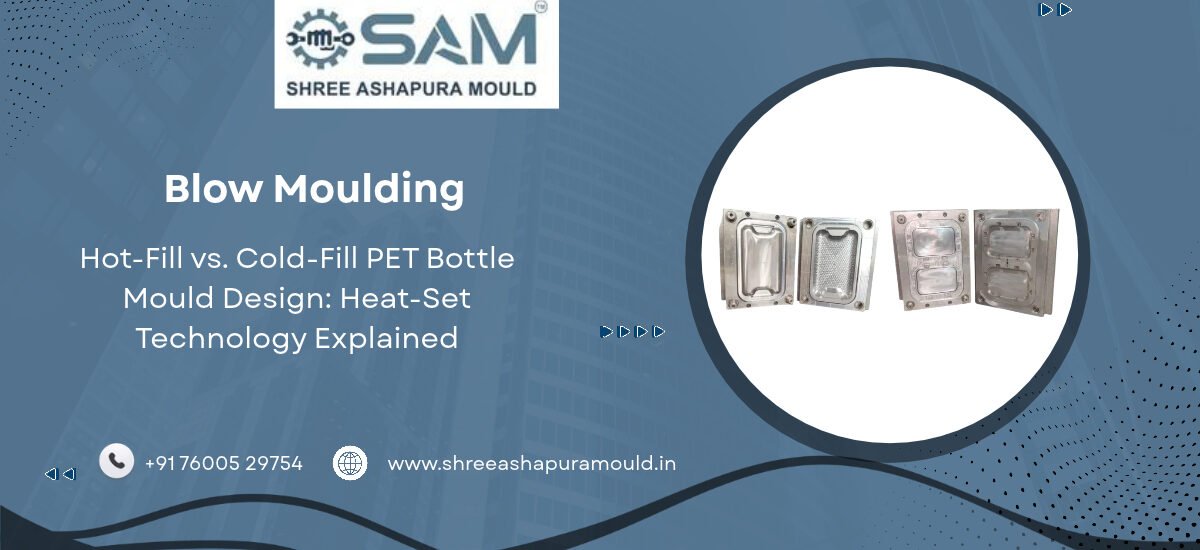
Hot-Fill vs. Cold-Fill PET Bottle Mould Design: Heat-Set Technology Explained
In the PET container manufacturing industry, bottle mould engineering is heavily dictated by the filling process used on the bottling line. While standard cold-fill containers for water and carbonated drinks are processed at ambient temperatures, sensitive products such as juices, teas, sports drinks, and liquid condiments require thermal pasteurization to eliminate bacterial contamination.
When hot liquid enters a standard cold-fill PET bottle, the thermal energy softens the amorphous polymer wall, causing severe container shrinkage, panel collapse, and neck distortion. To withstand filling temperatures up to eighty-five degrees Celsius without losing structural shape, hot-fill containers rely on specialized heat-set blow mould engineering.
Here is a technical comparison of structural mould design principles for cold-fill versus hot-fill heat-set PET bottle tooling.
Technical Comparison: Cold-Fill vs. Hot-Fill Moulding
Thermal Processing Environment: Cold-fill blow moulds operate with chilled water cooling to freeze the PET wall rapidly, whereas heat-set hot-fill moulds utilize high-temperature oil circulation inside the cavity walls.
Structural Wall Response: Cold-fill bottles rely on internal gas pressure or ambient ambient stability, whereas hot-fill bottles must resist thermal relaxation followed by internal vacuum forces upon product cooling.
Vacuum Panel Integration: Hot-fill bottle cavities feature flexible vacuum absorption panels along the body, whereas cold-fill cavities utilize smooth or simple decorative rib profiles.
Crystallization Level: Heat-set moulding increases the thermal spherical crystallization of the PET wall structure, enhancing thermal rigidity and barrier performance.
Neck Finish Specification: Hot-fill bottles require specialized thick-wall or thermally crystallized neck finishes to prevent ovality during capping at elevated temperatures.
Mechanical Principles of Heat-Set Tooling Technology
1. High-Temperature Oil Heated Cavities
In standard cold-fill moulding, chilled cavity walls freeze the blown PET film in an amorphous state. In heat-set hot-fill moulding, the blow mould cavity plates are machined with deep fluid channels connected to high-temperature oil heating units.
When the expanding PET preform contacts the heated cavity wall, the elevated steel temperature allows the polymer chains to realign into a highly stable crystalline matrix. This thermal relaxation phase eliminates internal residual stresses generated during stretching, preventing the bottle from shrinking when later exposed to hot liquids on the bottling line.
2. Vacuum Panel Engineering and Structural Geometry
As a hot-filled liquid cools inside a sealed container, the liquid contracts in volume and head-space steam condenses. This contraction creates a strong internal vacuum that pulls the bottle walls inward.
To prevent uncontrolled bottle distortion, hot-fill mould cavities incorporate specialized geometry:
Vacuum Absorption Panels: Rectangular or trapezoidal flexible panels engineered into the bottle body flex inward under internal vacuum pressure, absorbing the volumetric contraction without warping the overall bottle profile.
Horizontal Bumper Ribs: Structural ribs positioned between vacuum panels provide vertical column strength to maintain top-load capacity during stacking.
Base Push-Up Dome: The base cup insert features a steep inward dome designed to absorb hydraulic expansion during filling and inverted vacuum pressure during cooling.
3. Multi-Zone Thermal Management in Tooling Design
Heat-set blow moulds require precise temperature segmentation across different tool zones to ensure structural integrity:
Hot Body Cavities: Heated via circulating thermal oil to maintain constant high temperature along the main bottle sidewalls.
Cold Neck Ring Inserts: Chilled via independent water channels to prevent heat transfer from the cavity into the preform neck finish, protecting closure thread dimensions.
Chilled Base Inserts: Cooled with chilled water to solidify the thick, un-stretched gate area at the bottom of the container.
Tooling Application Engineering Standard
Cold-Fill Tooling Application: Ambient filling lines for packaged drinking water, carbonated soft drinks, edible oils, and personal care products requiring fast cycle times and chilled cavity operation.
Hot-Fill Heat-Set Tooling Application: High-temperature beverage filling lines for natural juices, ready-to-drink teas, sports hydration drinks, and pasteurized liquid foods requiring thermal structural stability and integrated vacuum panel geometry.
Related Precision Tooling Solutions
Looking for high efficiency blow tooling? Explore our precision Blow Mould manufacturing range engineered for hot-fill and cold-fill container designs.
Require matching high volume preform tooling? Learn about our advanced PET Preform Mould product line.
Complete your packaging line setup with custom-engineered PP Cap Mould solutions.



 Users Today : 6
 Users This Month : 180
 Total Users : 242