

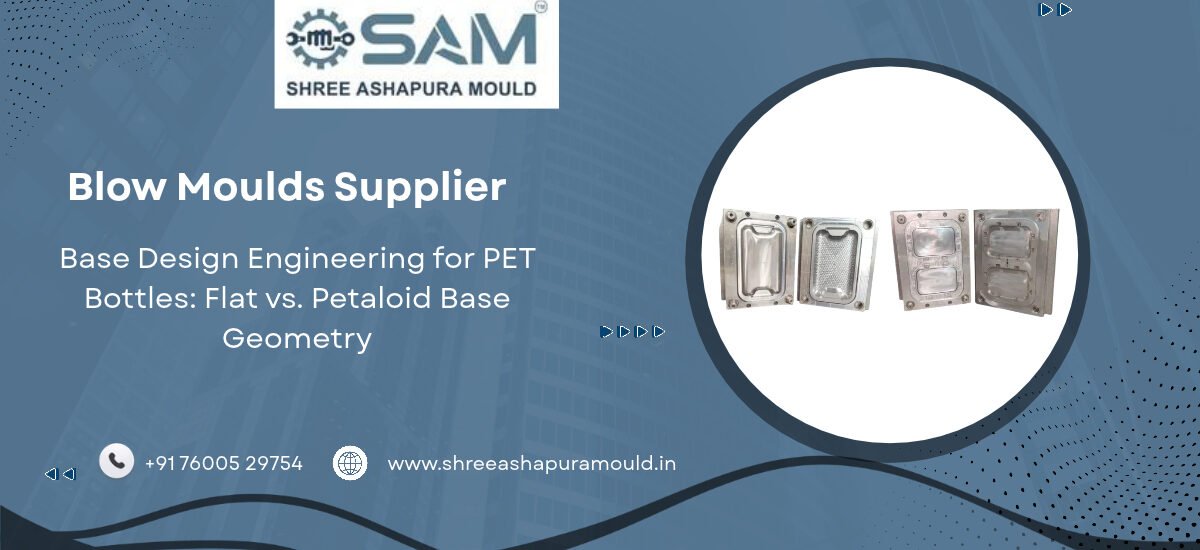
Base Design Engineering for PET Bottles: Flat vs. Petaloid Base Geometry
In stretch blow moulding, the bottom structure of a PET container is one of the most critical engineering zones. The base must balance multiple mechanical requirements: providing vertical column strength for pallet stacking, offering stability on high speed conveyor lines, resisting internal pressure expansion, and optimizing resin usage without causing thin spots.
Selecting between champagne flat base geometry and petaloid base geometry depends entirely on the physical properties of the packaged liquid, specifically internal carbonation levels, hot-filling temperatures, and drop-impact structural requirements.
Here is an engineering overview of the structural mechanics, stress distribution, and blow mould design parameters for flat and petaloid bottle bases.
Structural Comparison of Base Geometries
Champagne Flat Base: Features a smooth concave internal push-up dome surrounded by a continuous circular standing ring.
Petaloid Base: Features a multi-legged structure, typically five distinct feet separated by outward radiating valley ribs.
Primary Application: Champagne flat bases are used for still water, edible oils, juices, and spirits, whereas petaloid bases are engineered for carbonated soft drinks and sparkling beverages.
Internal Pressure Capability: Petaloid base geometry distributes high internal gas pressure across reinforced radial ribs, preventing base outward popping.
Vertical Load Distribution: Champagne flat bases provide high uniform top-load strength for non-carbonated containers under vertical compression during stacking.
Resin Distribution Requirement: Petaloid bases require precise preform stretch profiles to fill deep foot feet without creating localized brittle thick zones.
Technical Mechanics of Base Types
1. Champagne Flat Base Geometry (Still Beverages)
Non-carbonated liquids such as bottled mineral water, edible oil, and liquid detergents do not generate internal gas pressure pushing against the bottle wall.
Internal Push-up Dome: The center of the base features an inward-curved concave dome that shifts the center of gravity downward and prevents the gate area from touching the standing surface.
Continuous Standing Ring: A single unbroken circular ring around the perimeter provides smooth contact with conveyor belts, minimizing tipping or vibration during high speed packaging lines.
Material Efficiency: Because there are no deep feet corners to fill, preforms can be stretched thinner in the base region, reducing overall preform weight and material cost.
2. Petaloid Base Geometry (Carbonated Soft Drinks)
Carbonated soft drinks contain dissolved carbon dioxide gas that generates high internal hydrostatic pressure. This internal pressure exerts equal outward force against every interior square millimeter of the container.
Rib Interlocking System: Under high internal pressure, a flat container base would pop outward into a rounded sphere, making the bottle unable to stand upright. The five-legged petaloid structure utilizes alternating valley ribs that act as structural trusses.
Stress Dissipation: Internal gas pressure forces are transferred away from the central injection gate down into the valley ribs and outward toward the feet clearance tips, preventing central dome inversion.
Foot Clearance Alignment: The contact points of the five feet sit on a single horizontal plane, while the valley ribs remain elevated above the standing surface to maintain stability during pressure fluctuations.
Key Blow Mould Base Insert Design Factors
To ensure accurate base formation during stretch blow moulding, the base cup insert of the blow mould incorporates specific mechanical features:
Independent Base Water Cooling: The base insert absorbs heat from the thickest section of the expanding preform. Separate high-velocity water channels inside the base cup maintain tool surface cooling to freeze the PET material before mould opening.
Precision Clearance Tolerances: The vertical alignment between the main body cavity halves and the bottom base cup must maintain tight mechanical locks to prevent base mis-alignment and visible parting line seam flash.
Radial Exhaust Venting: Air trapped inside the deep feet recesses of a petaloid base insert must escape instantly. Micro exhaust channels machined along the feet valleys allow total preform expansion into the sharpest base corners.
Related Precision Tooling Solutions
Looking for high durability blow tooling? Explore our complete Blow Mould manufacturing range engineered for carbonated and still container designs.
Require matching preform tooling? Learn about our advanced PET Preform Mould product range.
Complete your packaging tooling line with custom-engineered PP Cap Mould solutions.



 Users Today : 6
 Users This Month : 180
 Total Users : 242