

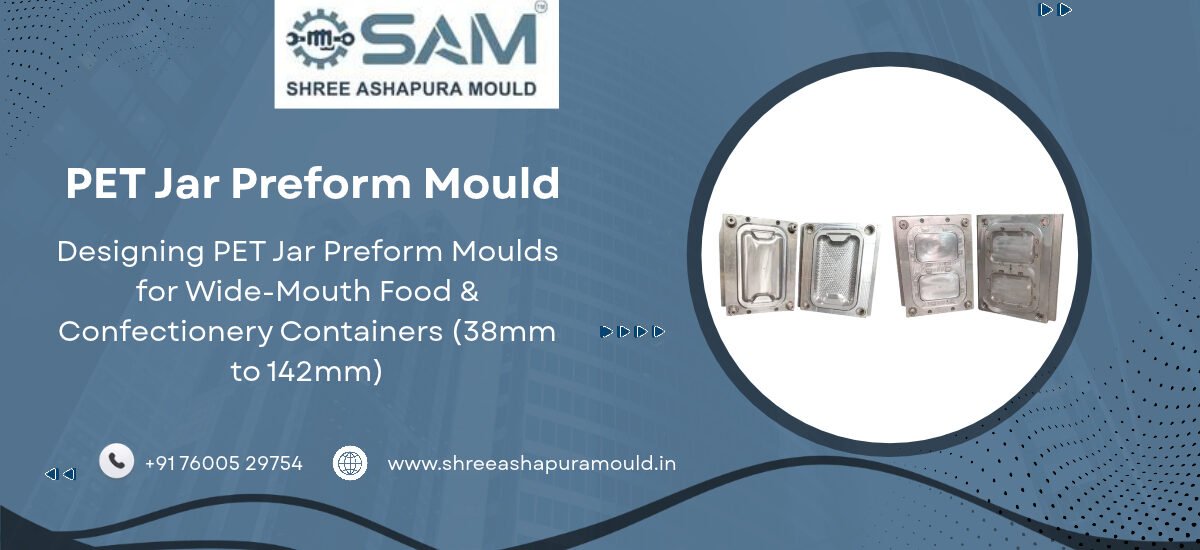
Designing PET Jar Preform Moulds for Wide-Mouth Food & Confectionery Containers (38mm to 142mm)
Wide-mouth PET jars are widely used across food, confectionery, pharmaceutical, and household chemical packaging due to their clarity, shatter resistance, and lightweight properties. However, producing preforms for wide-mouth jars—typically ranging from 38mm up to 142mm neck diameters—presents significantly different tooling and molding challenges than manufacturing standard narrow-neck beverage preforms.
Because wide-mouth preforms feature large neck diameters, lower stretch ratios, and heavy shot weights, the core-cavity design of a PET jar mould must maintain strict dimensional accuracy to prevent neck ovality, thread sink marks, and base distortion.
Here is an engineering overview of the core tooling parameters required for wide-mouth PET jar preform production.
Technical Differences: Bottle Preforms vs. Wide-Mouth Jar Preforms
Standard Bottle Preform               Wide-Mouth Jar Preform
   (High Stretch Ratio)                 (Low Stretch Ratio)
        |  |                               |       |
        |  |                               |       |
        |  |                               |       |
       (    )                             (         )
Key Mould Design Considerations for Wide-Mouth PET Jars
1. Controlling Neck Finish Ovality & Thread Shrinkage
Large-diameter neck rings (e.g., 63mm, 83mm, or 120mm) contain a substantial mass of molten PET. During cooling, the natural volumetric shrinkage of PET can cause the wide circular neck to become oval or warped.
Split Neck Ring Precision: Neck rings must be machined with guided taper locks and integrated cooling water channels surrounding the entire circumference of the thread area.
Shrinkage Compensation: Thread profiles must incorporate precise shrinkage allowances in the CAD tool model based on the specific intrinsic viscosity (IV) of the PET resin grade being processed.
2. Large Gate Orifice & Melt Delivery Management
Because wide-mouth jar preforms require higher resin volume per cavity (often $50\text{g to }250\text{g+}$ per shot), hot runner nozzles must deliver melt without generating excessive shear heat.
Increased Valve Pin Diameter: Valve pins and nozzle orifices are scaled up ($2.5\text{ mm to }4.0\text{ mm}$) to allow smooth, rapid cavity filling at lower injection pressures.
Balanced Thermal Profiles: Hot runner tips must maintain uniform thermal distribution across large gate zones to avoid gate crystallization (white haze) or cold slugs.
3. Core Pin Cooling in Large Diameter Cavities
Wide-mouth core pins have large internal volumes. If equipped with standard small-diameter bubbler tubes, dead cooling zones form around the core wall, leading to long cycle times and preform sticking.
Spiral Cooling Inserts: Utilizing helical spiral baffles inside large core rods forces chilled water to travel directly against the inner core surface, ensuring equal cooling rates along the entire diameter.
High-Conductivity Copper Alloys: Integrating copper alloy inserts into the core tip speeds up heat extraction at the thick bottom section of heavy preforms.
4. Wall Thickness Ratio for Low-Stretch Blowing
Because wide-mouth jars stretch less during final blow moulding, the preform wall thickness directly influences final jar wall distribution.
Graduated Wall Transition: The preform body must feature a smooth, gradual wall taper from the shoulder to the base to prevent thin bands or folds during stretch blow moulding.
Related Precision Tooling Solutions
Looking for high-performance wide-mouth tooling? Explore our dedicated PET Jar Mould manufacturing capability.
Need standard beverage or oil preform tooling? Learn about our complete PET Preform Mould product range.
Complement your wide-mouth jars with precision caps: Discover our custom PP Cap Mould solutions.



 Users Today : 6
 Users This Month : 180
 Total Users : 242